Edizione Open Access gratuita
Disponibile
Disponibile
Acquista anche su


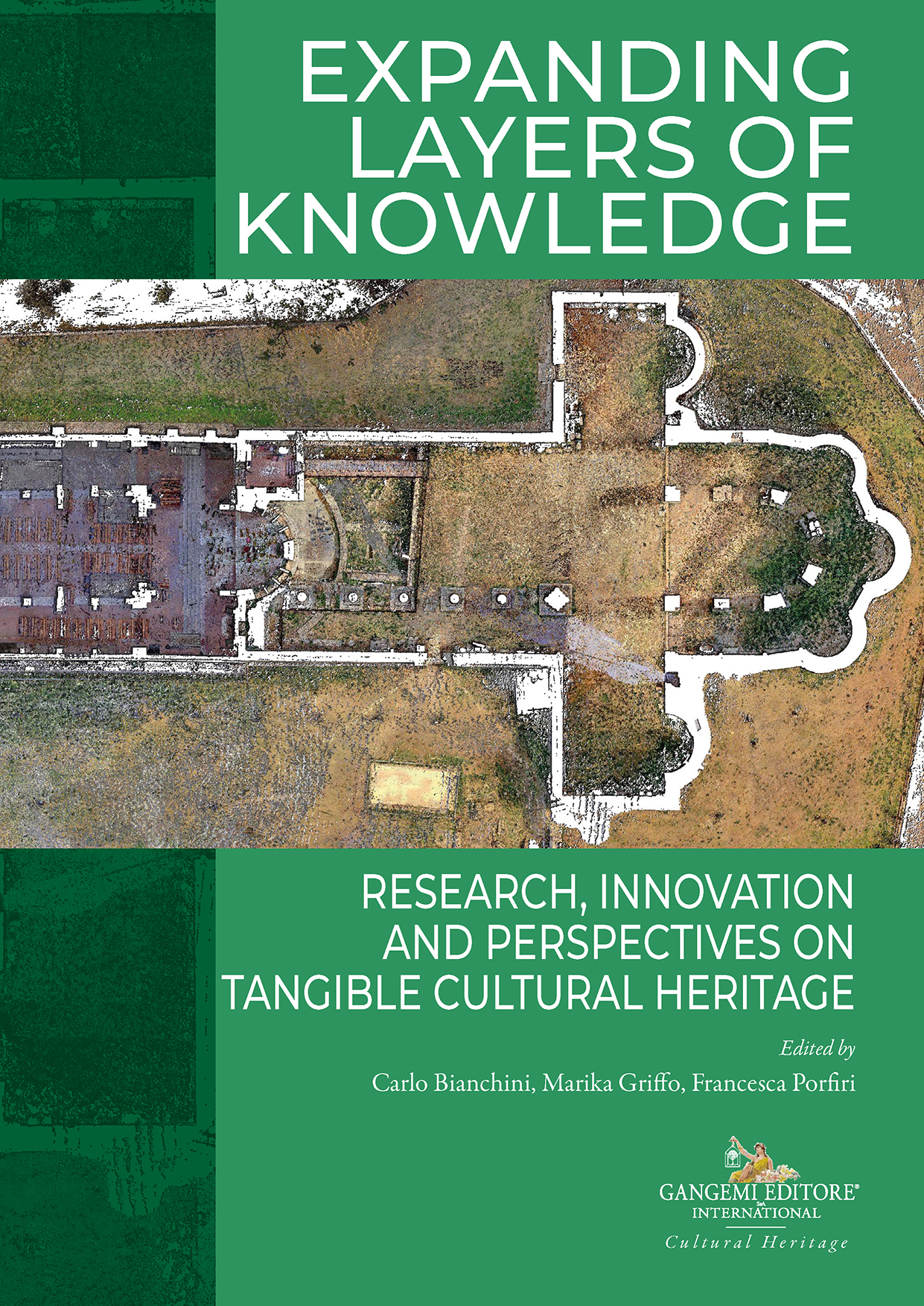
Expanding layers of knowledge
Research, innovation and perspectives on tangible cultural heritage
Autori: Bianchini Carlo, Marika Griffo, Porfiri Francesca
Formato:
Legatura:
Pagine: 358
Anno edizione: 2026
ISBN: 9788849256130
EAN: 9788849256130
UB. INT. :
Contenuto
Volume OPEN ACCESS scaricabile gratuitamente
This volume, Expanding Layers of Knowledge. Research, Innovation and Perspectives on Tangible Cultural Heritage, originates from the Study Days Layers of Knowledge. Space, Time, and Meaning, held in Venosa (Potenza) on 1-2 December 2025 as the concluding event of the activities carried out within Spoke 8 – Sustainability and Resilience of Tangible Cultural Heritage of the PNRR Extended Partnership PE5 CHANGES (Cultural Heritage Active Innovation for Sustainable Society). The relationship between the title of the conference and that of the present volume is intentional. The Study Days provided an opportunity to explore the multiple layers through which cultural heritage can be interpreted across space, time, and meaning.
This publication expands that reflection by bringing together research outcomes, methodological approaches, and future perspectives that emerged through three years of collaborative work. More than a record of the event, the volume offers a broader overview of the processes through which knowledge on tangible cultural heritage is generated, integrated, interpreted, and shared. Within the framework of CHANGES, Spoke 8 addressed the challenges of Tangible Cultural Heritage through an integrated research model combining technological innovation, scientific methodologies, and humanistic approaches. Its activities focused on the development of digital infrastructures and knowledge systems, the implementation of evidence-based evaluation methodologies, and the definition of strategies aimed at promoting sustainable, resilient, and participatory models of heritage management.
The Study Days represented the culmination of this collective effort. Organised through the synergistic collaboration of the research groups involved in the Spoke 8, the event brought together, for the first time in a shared setting, all project partners alongside the teams whose initiatives had been funded through the cascade calls. This encounter generated a valuable opportunity for discussion and comparison among researchers, professionals, and institutions working from different disciplinary perspectives but within a common framework of objectives and methodologies. The resulting dialogue highlighted both the diversity of the research activities conducted during the programme and the coherence of the broader scientific vision that connected them. The thematic sessions reflected some of the principal methodological pillars developed within the project, including georeferencing strategies and digital inventories, the analysis of temporal stratifications in cultural heritage, and the semantic integration of heterogeneous datasets through advanced systems for querying, interpretation, and dissemination. Together, the contributions presented by partners and cascade-call projects demonstrated how archaeological research, architectural analysis, historical
investigation, digital technologies, governance models, and community-oriented approaches can converge within an integrated framework for heritage knowledge.
The first section presents the projects developed by the partners of Spoke 8 and is organised into three thematic areas: Archaeology and Historical Landscapes; Cultural Heritage, Communities and Value Creation; and Digital Methods and Information Systems for Heritage Knowledge.
The second section is dedicated to the projects funded through the cascade calls and focuses on Innovation, Governance and Intelligent Systems for Cultural Heritage, highlighting the contribution of new research initiatives that have expanded the scientific scope and impact of the Spoke. Taken together, the essays collected in this volume document the results of a significant research experience while also offering a reflection on the future of heritage studies. They demonstrate how the conservation, interpretation, management, and enhancement of tangible cultural heritage increasingly require collaborative, interdisciplinary, and technologically informed approaches.
Ultimately, the experience documented in these pages can be understood as an effort to build a lasting memory capable of crystallising multiple perspectives on cultural heritage and of preserving the richness of the dialogues, methodologies, and research practices that emerged throughout the project. The plurality of contributions collected in this volume reflects the diversity of approaches through which heritage can be investigated, interpreted, documented, and communicated, while also highlighting the increasingly central and transversal role of digital methodologies.
The dialogue fostered during the Study Days in Venosa showed that one of the most important legacies of Spoke 8 lies not only in the tools, datasets, and methodologies developed, but also in the network of relationships, exchanges, and collaborations that will continue to generate new research trajectories beyond the conclusion of the project.
The choice of Venosa as the venue for the Study Days carries a significance that extends beyond its role as one of the project’s case studies. The Spoke challenge was to gather scholars, researchers, and professionals from institutions across Italy in a place that remains outside the country’s most frequented academic and tourist destinations reflected one of the fundamental principles underlying both CHANGES and Spoke 8: the recognition that cultural heritage knowledge and innovation should contribute to strengthening the visibility, accessibility, and resilience of territories beyond established centres of attraction. For two days, Venosa became a national hub for discussion on cultural heritage research, bringing together scholars and research teams from across Italy in a collective reflection on the challenges and opportunities facing contemporary heritage studies, demonstrating how places often perceived as peripheral can instead occupy a central position in the production of scientific knowledge and cultural value. In this sense, the location itself became part of the message conveyed by the project, reaffirming the importance of investing in cultural landscapes whose richness deserves broader recognition.
Given the venue, a particular attention was devoted to two case studies of the Spoke: The Complex of the Santissima Trinità in Venosa and the Cathedral of Acerenza. An exhibitions was organised during the Study Days to present the 3D documentation campaign results; while the guided visits to both sites, held by the allowed participants to engage directly with the local architectural and archaeological heritage. These activities fostered a productive dialogue between technological innovation and historical interpretation, showing how digital tools can support broader processes of cultural understanding and heritage enhancement.
Il volume è pubblicato con licenza Creative Commons Attribuzione-Non commerciale-Non opere derivate 4.0 Internazionale (CC-BY-NC-ND 4.0).
Parole chiave
Condividi su